|
2. Guided discussion
Even when women know the risks and know how to protect
themselves, there are many reasons why they do not practise safer sex. Many
things can make it hard for women to choose safer sex. Ask your group to list
reason why safer sex is hard for many women, and then to discuss what women can
do about this.
|
* * * * * * * * * * * * * * * *
 This discussion may be very difficult for
some women. If it is hard to get discussion going, you might want to give these
reasons one at a time and ask women to imagine situations where this might be
true. This discussion may be very difficult for
some women. If it is hard to get discussion going, you might want to give these
reasons one at a time and ask women to imagine situations where this might be
true.
|
|
* Make two lists.
* On the first list, write down what can
make it hard for women to choose safer sex.
* At the bottom of this list,
write down what makes it impossible for women to choose safer sex.
* On the
second list, write down what can make it easier for women to choose safer
sex.
* Some questions to consider:
- What can make it hard for women to choose safer sex? (Not
believing women or lesbians are at risk; not being prepared; afraid to be seen
as "easy" if they use or carry condoms; hard to talk to partner or initiate
sex; embarrassed to talk about sex; in her culture, women don't talk about
this; partner does not like her to discuss this; partner or peer pressure;
partner won't listen or tries to talk her out of her feelings; says she doesn't
care about or trust him; safer sex implies partner is "unclean"; housebound
women rely on partners to shop; women rely on men to use male condoms; the
desire to get pregnant; losing control due to substance/alcohol use or desire;
forced sex; economic dependence and poverty; partner unfaithful.)
- What can make it easier for women to choose safer sex?
(Partner knows about safer sex; wants safer sex; they trust each other; they
talk about making sex safer; partner wants her to feel safe during sex, listens
to and doesn't try to change how she feels; people are prepared; had good
sexual experiences before.)
- What are some solutions to the barriers to safer sex?
(Separate safer sex education for women and men; safer sex education in media;
affordable female condoms; support groups to help women work out safer sex;
safer sex plans; talk with partner before having sex; think about substance
use; work on self-esteem; work to end violence.)
3. Reading: "Safety and Sex"
|
* * * * * * * * * * * * * * * *
This is a great
pamphlet for more advanced learners.
|
|
* Read and discuss the ideas for working out safety with a male
partner, from the pamphlet "Safety and Sex: some comforting safer sex info for
women who have sex with men."
4. Practising skills: Asking for
safer sex
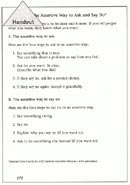
* Give learners a copy of "The assertive way
to ask and say no".
* Demonstrate different ways to use the four steps
of assertive asking.
* Read each step separately, asking learners to give
examples of the step.
* Then put the steps together. For example:
(1) "I'm worried about HIV."
(2) "I want to have sex with
you if we [use a condom]."
(3) "If you don't want to [use a condom], is
there anything else we can do in sex? How about [touching each other]?"
(4)
"Okay. . . shall we go for a walk?"
* Ask learners to try the four steps of assertive asking in
partner pairs.
* If some partner pairs are finished before others, you can
invite learners to repeat the activity differently, or to ask for something
else (for example, to use a dam for oral sex).
* Ask if any learners
want to present their work to the group, and discuss. Some questions to
consider:
- Should women always be assertive?
- Is it always safe to be assertive? When is it not safe?
- How can women act assertively about safer sex without asking
for safer sex?
|